

- Understand how eligibility appears to customers in the New Return Portal.
- Configure eligibility conditions in the admin dashboard using return policy rules.
- Set up Tracking Fallback settings to prevent missing delivery dates from affecting eligibility logic.
- Test your setup safely using Preview Mode (no RMAs created).
- Access to the Admin Dashboard
- Permissions to edit Settings (including Return Policy and Store Settings)
If you can’t see these menus, confirm your role/permissions with your team.
- List all scenarios you want to allow or deny, such as “Final sale items not eligible” or “Eligible for 30 days from delivery”.
-
Decide which eligibility level each scenario belongs to:
- Order-level (such as order creation/delivery date, order tags, payment type)
- Customer-level (such as location, customer type, customer tags)
- Item-level (such as item tags, price paid, discount code, vendor)
- RMA-level (such as total value or weight of items selected in the return)
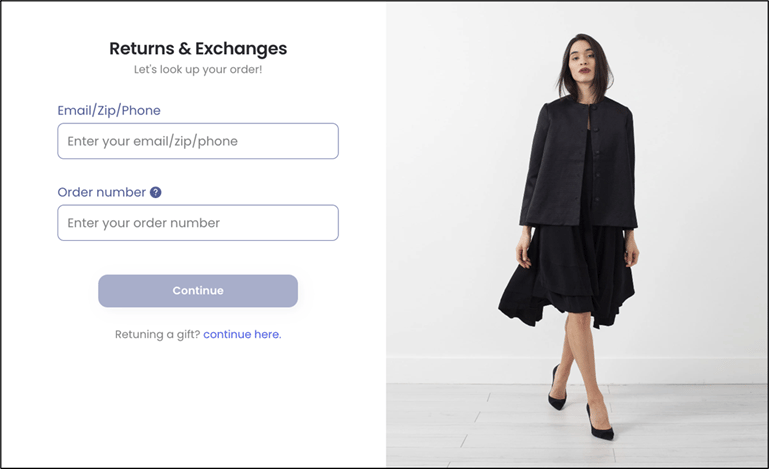
- Access the New Return Portal.
-
Enter the customer’s order ID and the required identifier (email, ZIP, or phone number).
-
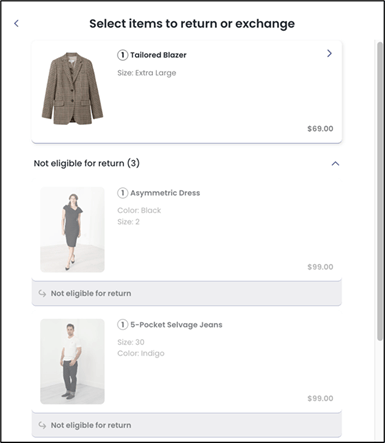
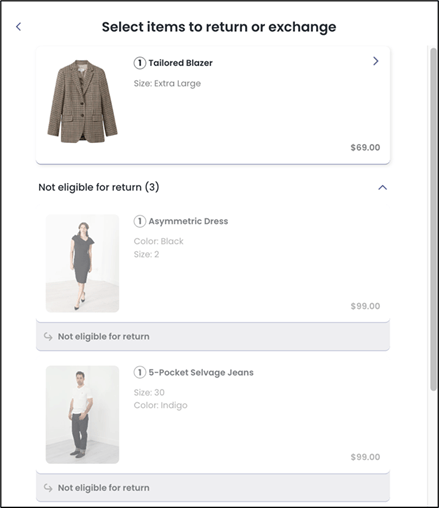
Load the order and review the item list:
- Eligible items are selectable.
- Ineligible items are shown as not eligible and cannot be selected.
- Navigate to Settings > Return Policy.
- Locate a policy rule.
- Navigate toSettings > Return Policy.
- Click ADD RULE.
- On the Detailspage, configure the rule basics.
- For example, you can configure rule name, resolution, return method. Note that fields may vary by account.
- At the bottom of the page, click Eligibility.
- Navigate to Settings > Return Policy.
- (Optional) Click EXPAND ALL to find the rule quickly.
- Click the pencil icon to the far right correspond to the policy rule you want to edit.
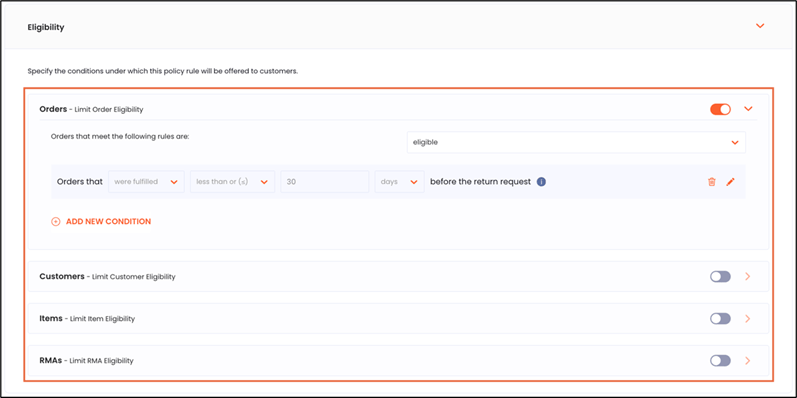
- Click Eligibility.
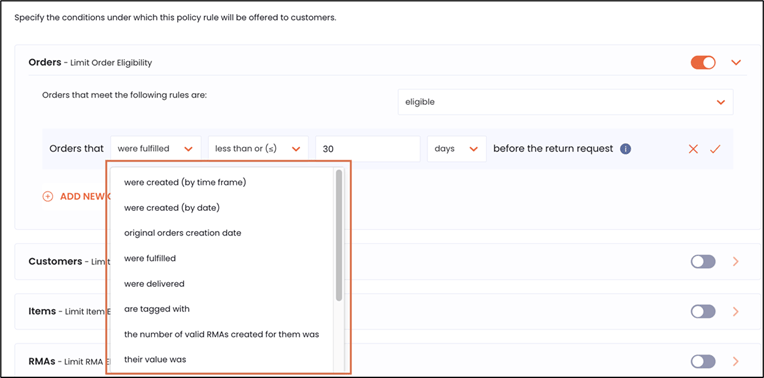
- Eligibility based on order creation time frame
- Eligibility based on order creation date
- Eligibility based on original order creation date (days or months)
- Eligibility based onorder fulfillment date (if fulfillment date is missing, the fallback is order creation date)
- Eligibility based on order delivery date (if delivery date is missing, the fallback depends on Tracking Fallback settings)
- Eligibility based on order custom attributes (all/some/none; comma-separated; not case sensitive)
- Eligibility based on the number of RMAs created (for the order)
- Eligibility based on order value
- Eligibility based on payment type (including whether paid with gift cards: only/partially/without)
- Eligibility based onincluded items
- Eligibility based on custom attribute
- Eligibility based on purchase source or sales channel
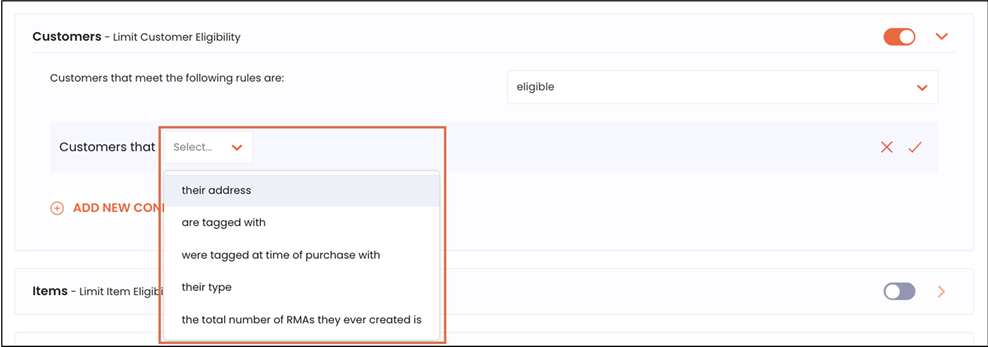
- Eligibility based on the customer’s location (uses OR logic across selected locations)
- Eligibility based on customer attribute (current attributes)
- Eligibility based oncustomer type (Registered/Guest)
- Eligibility based on the number of RMAs created by the customer
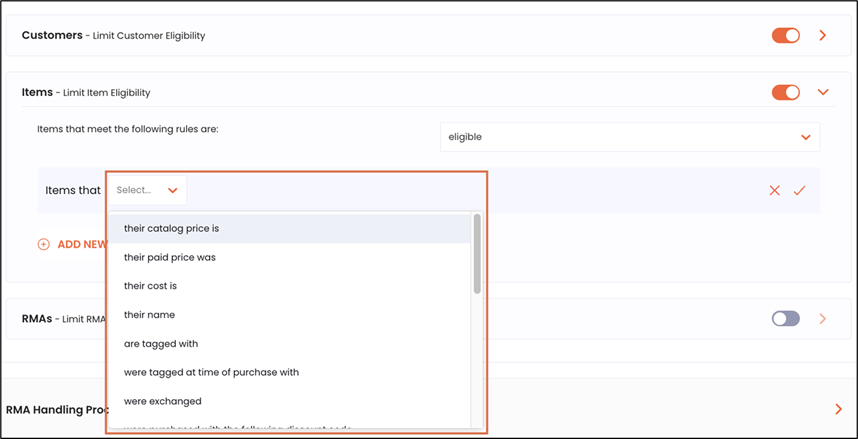
- Catalog price, paid price, cost
- Item name (contains/is and opposites; comma-separated; not case sensitive)
- Item attributes
- Number of exchanges
- Discount codes (contains/is and opposites)
- Discount value (amount/percentage/comparative price percentage)
- Total compare-at price and discount % (discount codes not included)
- Return reason (limit offered resolutions based on the selected reason)
- Item weight, vendor, collection ID, custom attribute (key/value)
- Item fulfillment
- Percentage of the order value
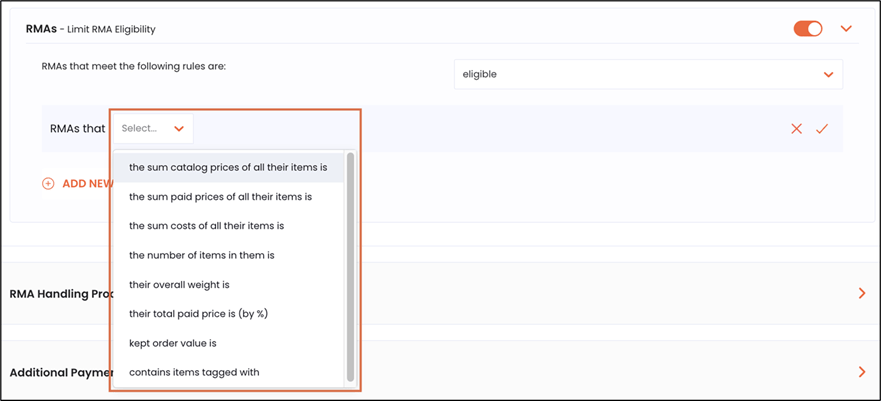
- Total listed price, total paid price, total cost
- Number of items being returned (raw item count)
- Overall weight
- Percentage of the order value
- Kept order value
- Enable Activate Policy Rule.
- Click the saveicon located in the top right corner of the page.
Saved changes will not affect the New Return Portal unless the rule is activated.
- Navigate to Settings > General.
- Expand the Tracking Fallback section.
-
Set When to refer to orders to Delivered.
Used when checking eligibility conditions, such as Orders that were delivered…, with a missing delivery date.
-
Set When to refer to in-transit return shipments as Delivered.
This is used for automations triggered by a return shipment’s status.
- Click the saveicon in the top right corner of the page.
-
Test safely using Preview Mode:
- Navigate to the Admin Dashboard Homepage.
-
Click PREVIEW MODE.
A new tab opens with the New Return Portal and a Preview Mode label (top right-hand corner of the page).

-
Enter a real order ID and test different scenarios (eligible vs not eligible items).
Preview Mode lets you test without creating RMAs or sending notifications.
-
Confirm the customer-facing behavior in the New Return Portal:
- Verify that eligible items are selectable, and ineligible items are marked not eligible.
-
Confirm the specific scenario you configured (such as date window, tags, reason, etc.) behaves as expected.
-
Do one of the following:
- If you created a real RMA - in the Admin Dashboard, verify your eligibility settings.
-
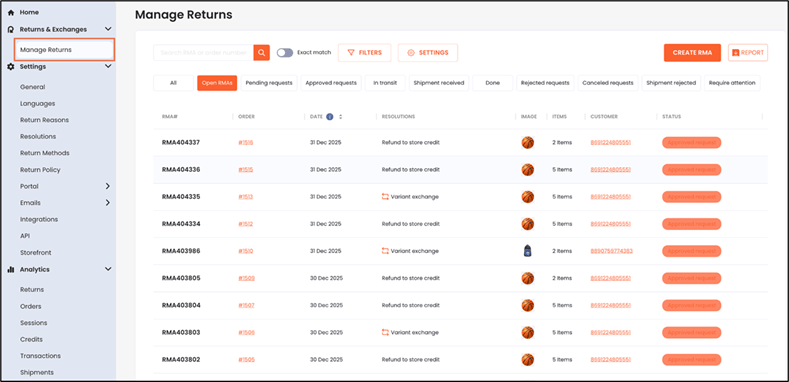
If you tested outside of Preview Mode and submitted a real return - navigate to Manage Returns and open the RMA to review what was returned and the results.
| Issue | Solution |
|---|---|
| Nothing changes in the New Return Portal | Confirm the rule is toggled Activate Policy Rule = ON and saved (save icon). |
| Delivery-based rules behave inconsistently | Configure Tracking Fallback so missing delivery dates don’t block eligibility checks. |
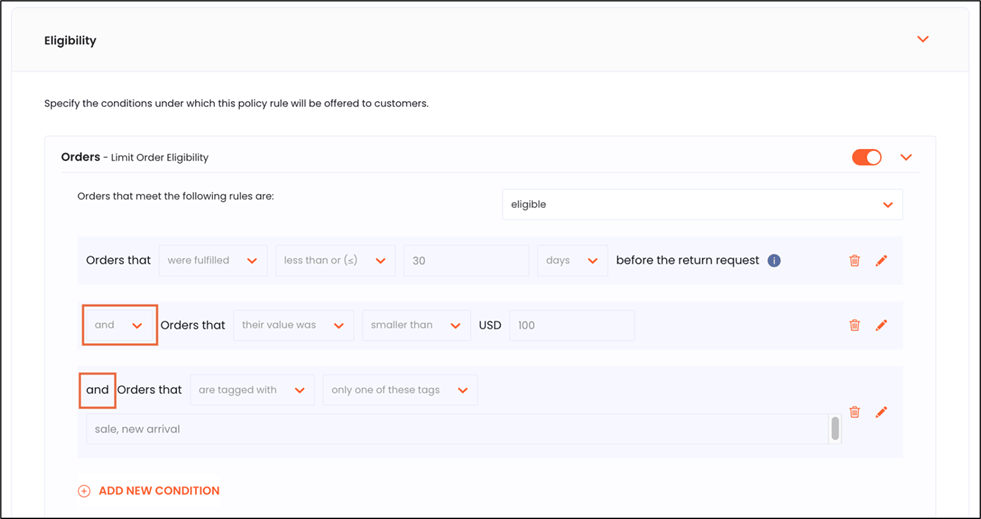
| Complex logic not working | You can’t mix AND and OR within the same eligibility level. Split logic across multiple rules or levels. |
| Expected item data is missing | Deleted/null items aren’t supported for eligibility checks (no item data to process a return). |
| Tag rules not matching | Tags are not case sensitive; comma-separated values represent “A or B or C.” Also confirm whether the condition checks all/some/none. |